
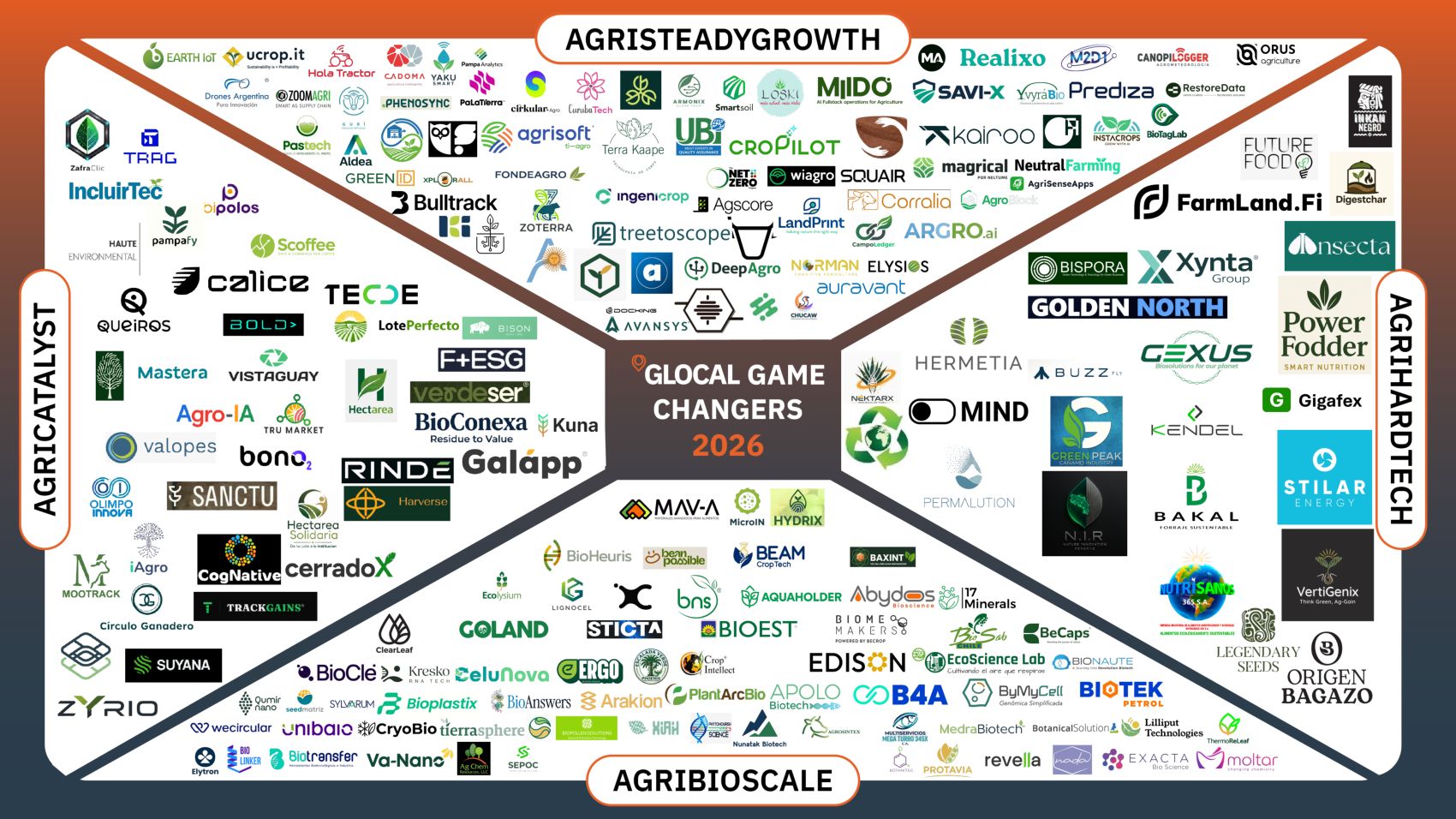
A new generation of founders is building capital-efficient, IP-rich companies across 27 countries, and most of them are already selling.
Latin America feeds a large share of the world. It is a leading exporter of soybeans, coffee, beef, sugar and fruit, and home to some of the most productive farming systems on the planet. So it should be no surprise that the region is also producing a growing wave of agrifoodtech entrepreneurs.
This year, GLOCAL Game Changers 2026 (GGC2026), our open call for early-stage agrifoodtech startups, received more than 300 applications from 27 countries. Reviewing every one of them gave us an unusually wide view of where the ecosystem stands: real strengths and a few challenges worth naming. Five trends stand out.
- Founders are building leaner companies
Each year we sort applicants using the four startup archetypes defined in GLOCAL’s Clean AgriFoodTech Playbook, our investment framework for the sector: fast-adoption software (AgriCatalyst), field-deployed tools that grow through trust with farmers (AgriSteady Growth), IP-driven, asset-light biotech (AgriBioScale), and capital-intensive businesses that run their own plants, farms or land (AgriHardTech).
Compared with GGC2025, the mix has moved clearly toward lighter models. Last year, a quarter of the startups we mapped were capital-intensive AgriHardTech. In GGC2026 that share fell to 12%, while software and asset-light biotech grew: AgriCatalyst rose from 13% to 20% and AgriBioScale from 25% to 30%. Part of the change reflects a digital-agriculture track added to the program this year, but even without it the AgriHardTech share fell to 14%.
Latin American founders are increasingly building companies where value sits in data, software, IP and licensing, which need less capital to grow and fit the economics of venture investing. The median round they are raising is about USD 700,000, an efficient entry point for investors.
- The science runs deep
93% of the startups have at least one founder with a scientific or technical background. 45% already hold proprietary IP, and another 36% are in the process of securing it, so more than four in five are building defensible technology.
Biotech is especially strong. Among asset-light biotech startups, working on biologicals, RNA-based crop protection, gene editing and precision fermentation, 55% already hold IP. 41% of them are moving through regulatory registration or expect a long pathway. That is a pipeline of new products heading toward market in some of the world’s largest agricultural economies, but also a reminder that biotech timelines are set by regulators, country by country, and investors need to plan their reserves accordingly.
- Most are already selling
Half of the startups report a product launched and in the early commercial stage, and seven in ten are already generating revenue: 34% have their first paying customers, 31% are scaling, and 6% are expanding into new markets. About 30% are still pre-revenue.
Brazil leads on commercial maturity: 57% of Brazilian applicants report traction or scaling. Argentina contributed the most applications (38%), followed by Brazil, Colombia, Mexico and Chile; Argentine applicants tend to be at an earlier stage, with 22% reporting traction or scaling.
For many of these companies, the hardest step is still ahead: turning first customers into repeat customers. Farmers operate on tight margins and adopt new tools only when the return is clear. That transition, from a launched product to a proven one, is exactly where early investors and corporate partners can add the most value.
- Women are leading, but mostly in science
59% of the startups have women in their C-level teams, a figure few venture markets can match. But the distribution is uneven. In asset-light biotech, the share is 78%, and in innovative food ingredients it reaches 88%. In fast-adoption software, it is 40%, and in farm-management tools, only 33%.
The trend also deserves attention. Among field-deployed tools (AgriSteady Growth), the share of startups with women in leadership fell from 59% in 2025 to 49% this year. Digital agriculture is where women’s representation in leadership teams is thinnest, and closing that gap should be a priority for the whole ecosystem.
- Impact is on the agenda, but not yet measured everywhere
Nearly every startup frames its business around the UN Sustainable Development Goals, led by responsible consumption and production, climate action and zero hunger. Six in ten already track their impact, mostly through their own indicators, but measurement is still a work in progress: 38% don’t measure yet, and only 10% have external certification or audits.
Capital-intensive climate and circular-economy companies lead the way, with 19% already externally verified. Software companies lag (48% don’t measure yet), yet they have the biggest opportunity: their own transaction data can prove outcomes at almost no extra cost, which turns impact measurement into an advantage when they raise their next round.
What founders want: partners, not just capital
When we asked founders what they need from investors, 87% said capital, but 58% also asked for introductions to clients and 53% for access to networks. Among pre-revenue startups, 62% want early adopters, almost as many as want funding.
This is an open invitation to corporates, cooperatives, input companies and lenders. A pilot, a field trial or a distribution agreement can do as much to accelerate these companies as a check.
Why now
Three things make this a compelling moment for anyone interested in Latin American agrifoodtech:
- Capital efficiency. Founders are choosing asset-light models with modest round sizes and clear paths to strategic partnerships and acquisitions.
- Defensible technology. A deeply technical founder base, with more than four in five startups holding or building IP, is creating assets with global relevance.
- Commercial momentum. Seven in ten startups already have revenue, and many are ready to scale with the right partners.
Latin America’s agrifoodtech founders are building for some of the world’s most important agricultural markets, with strong science, diverse teams, and growing commercial traction. The opportunity for investors and corporates is to help them scale faster.
📄 Want the full report? Reach out at [email protected].